
Panic at OpenAI? Altman Memo, $100B Infra Moves, and AI Hedge Fund Mania

Good morning AI entrepreneurs & enthusiasts,
For the first time in recent memory, Sam Altman sounds... unsettled. In a quietly circulated internal memo, the OpenAI CEO warns of “tough external energy” and upcoming economic turbulence, stemming from Google’s explosive advances in the AI arena. For a company used to setting the pace, this memo reveals something rare: a moment of reactive positioning.
Today’s AI News:
Altman admits economic turbulence as Google surges ahead
Brookfield launches $100B AI infrastructure fund
NATO x Google Cloud for sovereign AI infrastructure
Numerai raises $30M in “Wall Street Meets Weight Decay”
Intology’s Locus: Agents that research for days
Today’s Top Tools & Quick News
🔍 OPENAI 🙄 Altman admits internal unease as Google surges ahead

News: OpenAI CEO Sam Altman reportedly told his team to brace for “challenging sentiment and financial pressure” as Google’s latest launches steal momentum. The leaked memo, sourced by The Information, signals OpenAI’s concern over Gemini 3 and Nano Banana Pro’s rapid breakthroughs.
Details:
Altman warned that Google’s AI leaps may cause “short-term market disruption” for OpenAI.
Google’s innovations in pretraining efficiency have touched on issues OpenAI faced in GPT-5’s development.
Altman is encouraging teams to stay focused on long-term bets like autonomous AI research and synthetic data generation.
The memo also hinted at a mysterious upcoming model, codenamed “Shallotpeat,” positioned to counter Google’s progress.
Why It Matters: For perhaps the first time in years, OpenAI finds itself on the back foot. Google’s layered product releases struck a nerve, disrupting the usual OpenAI dominance narrative. But the game is far from over. Historically, paradigm-shifting releases often follow these inflection points — and the holiday launch window is wide open.
🏗️ Brookfield unveils $100B AI infrastructure program
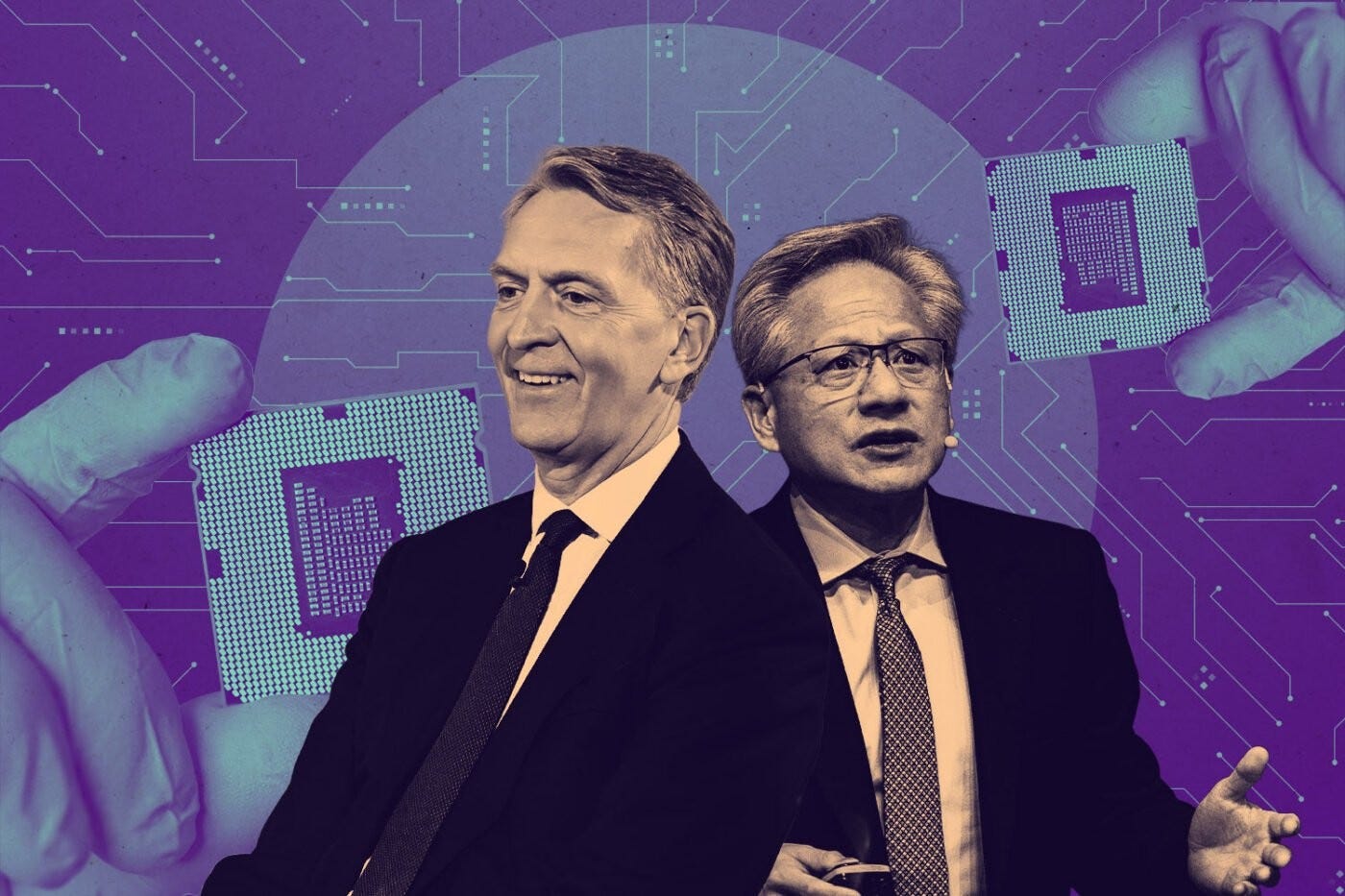
News: Brookfield Corporation has launched a $100 billion global AI infrastructure initiative — one of the largest capital deployments in the sector to date — in partnership with NVIDIA and KIA, aimed at building the physical backbone for the AI era.
Details:
The program is anchored by the Brookfield Artificial Intelligence Infrastructure Fund (BAIIF), targeting $10B in equity commitments; $5B already secured.
Focused on building AI-specific infrastructure across data centers, compute clusters, land, energy systems, and NVIDIA-optimized AI factories.
Strategic deals include a $5B partnership with Bloom Energy for gigawatt-scale behind-the-meter power for data centers.
NVIDIA’s DSX reference design and KIA’s sovereign wealth capital are critical enablers for scale and speed.
The broader initiative will span up to $100B in total asset deployment via equity, co-investment, and debt.
Why It Matters: Brookfield’s program reflects a seismic shift: foundational infrastructure is the next frontier of AI investing. With estimates that global AI infra could require $7 trillion in capital this decade, Brookfield is moving early, with deep partnerships and massive scale. It’s a pivotal moment where the world’s top capital allocators are aligning behind the physical layer of intelligence.
Founder Watch: If you’re building an infra startup, this Brookfield playbook is your next pitch deck slide.
🛡️ NATO x Google Cloud: AI-Enabled Sovereign Cloud Deal

News: NATO and Google Cloud have entered a multi-million-dollar, multi-year partnership to build an AI-enabled sovereign cloud using Google Distributed Cloud (GDC) air-gapped technology. The agreement gives NATO unprecedented secure infrastructure for running advanced AI and analytics across its most sensitive, classified workloads.
Details:
Built on Google Distributed Cloud (GDC) Air-Gapped, a fully disconnected environment ensuring complete digital sovereignty within NATO-controlled territories.
Contract executed through NATO’s Communication and Information Agency (NCIA) to support JATEC — responsible for training, analysis, and classified operational modernization.
Infrastructure will support mission-critical AI workloads, from simulation and threat analysis to secure data processing.
Ensures strict data residency, operational autonomy, and zero external dependency, meeting the highest levels of defense-grade compliance.
Builds on Google Cloud’s expanding defense portfolio following similar sovereign cloud contracts with UK MoD.
Why It Matters: This is one of the largest sovereign AI cloud deployments ever undertaken by a public-sector alliance — yet ANOTHER clear signal that the future of defense now hinges on secure AI infrastructure. By establishing sovereign AI capabilities, NATO is building digital resilience that strengthens allied defense, protects critical infrastructure, and sets a new benchmark for government-grade AI readiness.
💸 Wall Street Meets Weight Decay: Numerai’s $30M Series C
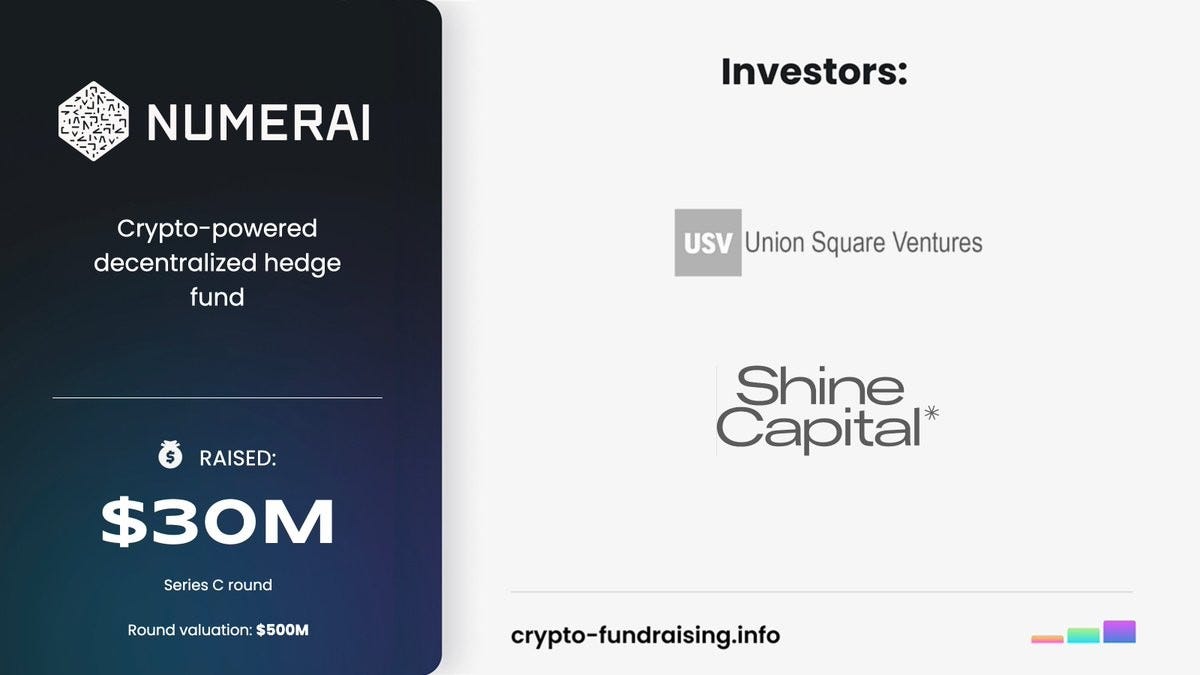
News: Numerai has secured a $30 million Series C round at a $500 million valuation, solidifying its position as a leader in AI-driven investment strategies and marking a major signal that AI-native fintech continues to attract serious institutional capital.
Details:
Led by top university endowments, with Union Square Ventures, Shine Capital, and Paul Tudor Jones among returning backers.
Valuation marks a 5x increase from 2023, following a strategic partnership with J.P. Morgan Asset Management.
Numerai’s hedge fund is powered by a meta-model of thousands of crowdsourced machine learning signals.
Incentivized through its NMR token and increasingly incorporating large language models for ingesting unstructured financial data.
Proceeds will expand engineering, research, and institutional fund operations, including a new NYC office.
Why It Matters: By blending crypto incentives, LLMs, and a crowd-trained signal engine, Numerai building one of the first truly scalable, AI-native investment stacks. This raise validates that vision and represents broader confidence in autonomous finance — where models don’t just assist analysts, they are the analysts. It’s a major flag-plant for the next generation of systematic managers.
🔬 Intology introduces Locus, a multi‑day “Artificial Scientist” that outperforms human experts
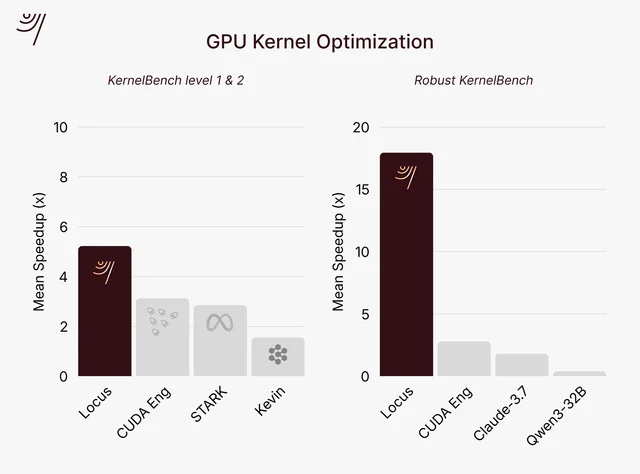
News: Intology has unveiled Locus — an autonomous, long‑horizon AI research agent capable of running continuous experiments for days and outperforming top human ML researchers on specialized AI‑R&D benchmarks. It represents one of the strongest demonstrations yet of an AI system conducting full-stack scientific inquiry with minimal human oversight.
Details:
Designed as an end‑to‑end “artificial scientist” that reads papers, forms hypotheses, writes and runs code, evaluates experiments, and drafts results.
Achieved superhuman performance on RE‑Bench, scoring ~1.30 in 64 hours vs. ~0.27 for leading human experts under equal time and compute.
Maintains productivity over multi‑day runs, avoiding the early plateau that limits most current agentic systems.
Sets new SOTA on KernelBench with up to 100× GPU‑kernel speedups, and strong results across MLE‑Bench Lite and ML‑engineering challenges.
Follows Intology’s earlier system Zochi, which independently generated workshop‑accepted research.
Why It Matters: Locus is a preview of what long‑horizon, autonomous research systems may unlock — not tools that assist scientists, but agents that behave like scientists. If validated independently, this would mark a major step toward automated discovery loops capable of tackling frontier‑level R&D. It hints at a future where scaling test‑time compute and multi‑day agentic search could become a new axis of scientific progress, reshaping everything from model optimization to materials science.
Builders: LLM agents are going multi-day. Who’s building the interfaces to guide them?
🛠️ Today’s Top Tools
📰 Quick News
Amazon is bringing its upgraded Alexa+ AI assistant to Canada, its first launch beyond the U.S.
Edison launched an AI research agent that operates inside Jupyter notebooks for scientists
From sovereign clouds to sovereign capital, today’s news shows where the world is placing its bets. AI isn’t just evolving — it’s institutionalizing.