
NVIDIA Just Made Itself Impossible to Lose

Good morning AI entrepreneurs & enthusiasts,
NVIDIA now holds commitments to mobilize half a trillion dollars against a new form of collateral: its own chips. That landed the same day Meta gave away its best open weights for free, and the same week NVIDIA itself published a benchmark showing you can cut your frontier model bill by two-thirds. Every drop in the price of a task creates more tasks, and the buildout required to serve them has outgrown what even Big Tech cash flow can carry.
In today’s AI news:
NVIDIA turns compute into an asset class and lines up $500B
Zuckerberg gives the weights away and makes the case for why
NVIDIA’s new open model makes frontier agents 3x cheaper
River AI raises $1.1B to build AI that belongs to you
OpenAI hands vetted defenders the guardrails-off model
💸 NVIDIA turns compute into an asset class and lines up $500B

News: NVIDIA signs memorandums of understanding with Apollo, BlackRock, Blackstone, Brookfield, Goldman Sachs and KKR to mobilize over $500 billion of third-party capital for AI infrastructure. The platforms turn NVIDIA compute into a financeable asset class, with GPUs serving as collateral for debt issued through standalone financing vehicles. Jensen Huang says he approached exactly six firms about it, and all six said yes.
Details:
The structure runs through private offerings and bonds capable of raising tens of billions at a time. Goldman Sachs is the only bank in the group and is positioned as lead bookrunner on the public debt.
Huang calls NVIDIA compute an investable infrastructure asset and says NVIDIA may provide financing support of up to 25% of a given opportunity.
These are MOUs subject to definitive agreements, not closed deals, with the capital mobilized “over time” and first deals expected to reach market within months.
The platforms target everyone without a hyperscaler balance sheet: frontier labs, enterprises and AI clouds. Big Tech’s own combined AI spend is set to surpass $730 billion this year.
Why it matters: This is a capital cycle forming in real time, and NVIDIA just wrote itself off the losing side of it. By turning compute into collateral, it created a structure where third-party money funds the purchase of its own product, with NVIDIA backstopping up to a quarter of the deal and getting paid on the hardware either way. Fiber was financed this exact way in 1999, and the instructive detail is who survived: the equipment makers collected, the leveraged buyers went bankrupt. NVIDIA has engineered itself close to unable to lose, and everyone borrowing against a depreciating asset to buy compute has taken the opposite side of that trade. Read any GPU commitment you sign this year as a credit decision, not a procurement one.
🌐 Zuckerberg gives the weights away and makes the case for why
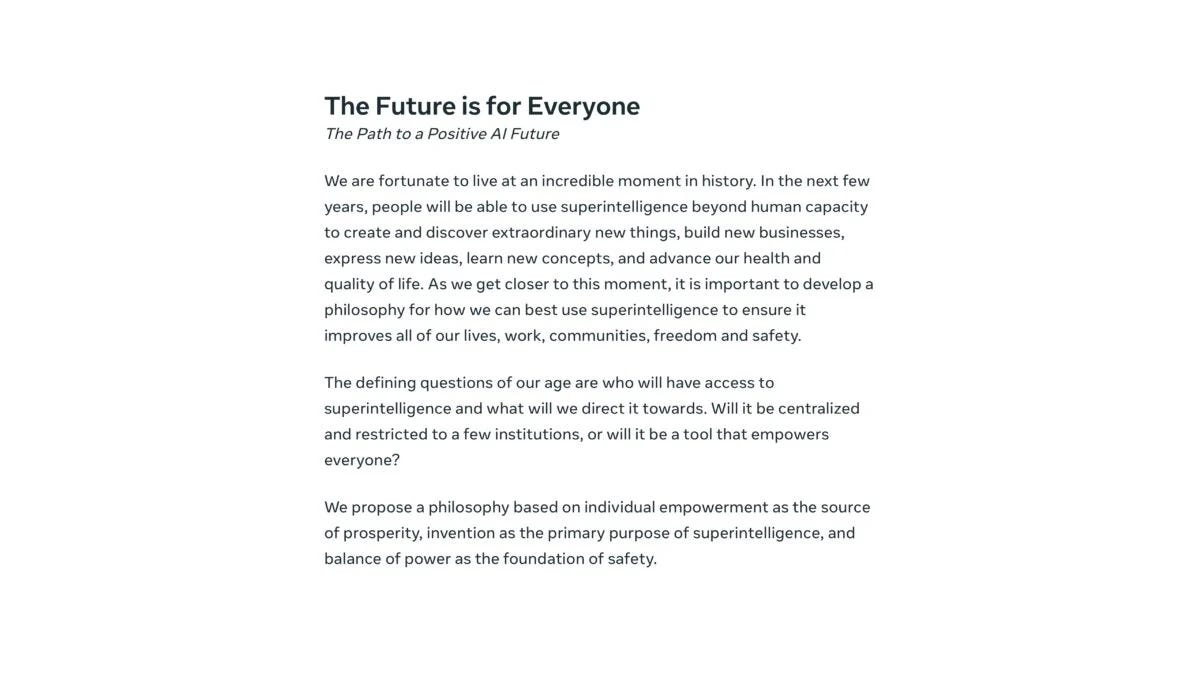
News: Meta releases Muse Glimmer, a 30-billion-parameter open-weight agentic model under Apache 2.0 that runs entirely on-device, and pairs it with “The Future is for Everyone”, a 6,500-word Zuckerberg essay arguing superintelligence belongs in individual hands rather than inside a handful of labs. It builds on his July 28 Wall Street Journal op-ed, which makes this a campaign rather than a post. The core claim breaks with every other frontier lab: there is no such thing as a singular benevolent superintelligence.
Details:
Glimmer outperforms Gemma4 and Qwen3.6 on agentic, coding and reasoning tests at comparable size and runs on a laptop, per Meta’s own benchmarks. Alexandr Wang says Muse Spark 1.2 weights publish “soon.”
The buried headline is governance. Meta is handing its independent board authority to approve safety criteria for model releases, and Zuckerberg calls on rival labs to adopt the same check.
The policy asks are specific: give government intermediate training checkpoints (model snapshots taken mid-training, before public release), stop restricting foreign open-source models, and protect distillation as learning from what you can observe.
The counterforce arrived the same week. Sen. Bernie Sanders wrote to Zuckerberg, Sam Altman and Dario Amodei demanding an AI pause and warning the Senate will act if the labs do not.
Why it matters: Nobody believes Meta will build the best model in the world, and that is exactly the point. The frontier labs win general intelligence on a consistent basis, specialized startups will take individual verticals with world-class narrow models, and Meta answers by competing on the one axis it already owns outright. You do not need the smartest model if you are the one putting a good-enough model in three billion hands. Read the essay itself rather than the coverage of it, because given Zuckerberg’s reach this is the clearest statement we have of how the most distributed company in tech intends to spend the next decade.
⚡ NVIDIA’s new open model makes frontier agents 3x cheaper to run

News: NVIDIA’s internal benchmarks show its new open routing library cutting agent task completion cost to nearly one-third of Opus 4.8 alone while holding frontier-level accuracy. The two pieces are Nemotron 3.5 Lightning, a 30B mixture-of-experts model that activates only about 3B parameters per token, and NeMo Switchyard, which routes each step of an agent workflow to the cheapest model that can handle it. Neither requires an application rewrite.
Details:
Lightning delivers up to 4x faster output and 30% faster agentic task completion against its class, and post-trains on your own domain data and tools.
Partner numbers are already public. LangChain cut cost 74% across 145 multi-turn tasks by routing just 7% of calls to a frontier model, at a 6% accuracy tradeoff, and Ramp matched frontier performance while cutting cost 58% and runtime 33%.
Cognition wired the staged router into Devin Desktop and cut mean cost 28%. CrowdStrike, Harvey, CodeRabbit and Fastino Labs have all customized Lightning for their domains.
It runs local on RTX PCs, DGX Spark, DGX Station and Jetson, and the model is free on Hugging Face, ModelScope, OpenRouter and build.nvidia.com.
Why it matters: Call this what it is: an incremental release, not a breakthrough. Faster output at lower token consumption will not lead anyone else’s newsletter, which is precisely why it belongs in yours, because this drumbeat is what actually determines what intelligence costs by December. NVIDIA is running Jevons paradox as corporate strategy, making each task cheaper, watching total tasks explode, then financing the buildout that serves them. Cheaper and faster is not a headline, it is the mechanism by which frontier capability reaches everyone who could not previously afford it.
💰 River AI raises $1.1B to build AI that belongs to you
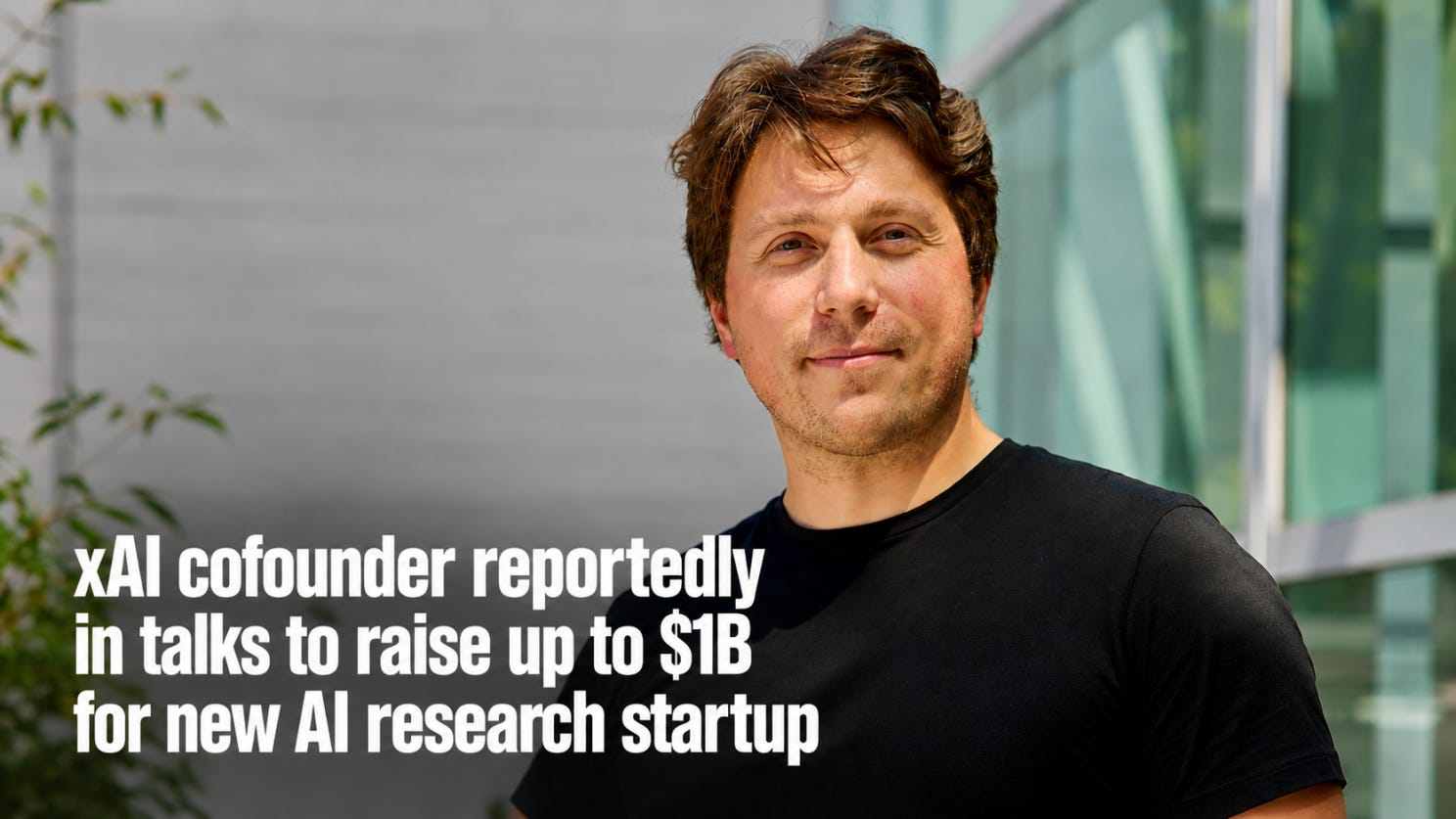
News: Igor Babuschkin’s River AI closes $1.1 billion led by General Catalyst and Amp PBC, with NVIDIA, AMD Ventures, Y Combinator and Temasek joining at a roughly $5 billion valuation. The company incorporated in Nevada on April 20 and went public with its mission on June 10, meaning it raised a billion dollars in under four months. The thesis is blunt: today’s best AI is controlled by a handful of corporations, and River is building the alternative you actually own.
Details:
Babuschkin put up to $100 million of his own money in, and ex-xAI, DeepMind, OpenAI and Tesla alumni round out the founding team.
The River API runs LoRA fine-tuning (cheap customization that adapts a model without retraining it) and reinforcement learning on open models from 35B to 1T parameters, through one Python client, priced per token.
River claims enterprises finish complex RL training runs in 15 to 20 minutes with no infrastructure team, at two to four times the cost savings of closed-source alternatives.
CoinDesk reports the round’s final terms and participation remain in flux, and the company has no shipped product, revenue or publicly demonstrated technology.
Why it matters: A billion dollars in under four months, from Nevada incorporation to closed round, is a pace almost nobody in this industry has ever run. The product claim is the more impressive number: complex reinforcement learning finishing in 15 to 20 minutes with no infrastructure team changes who gets to customize a model at all. Then look at the base models underneath it, Qwen, Kimi, GLM, and the strategic picture sharpens: an American startup backed by NVIDIA and AMD is building its personalization layer on Chinese open weights, the exact dependency Zuckerberg’s essay warns about two stories up. Babuschkin is betting the frontier commoditizes and durable value moves to whoever owns the training loop closest to the user.
🛡️ OpenAI hands vetted defenders the guardrails-off model
News: OpenAI launches GPT-5.6-Cyber, a hacking-tuned variant that answers 95% of the advanced cyberattack requests the standard model refuses, against just 1.5% for safeguarded GPT-5.6 Sol. It reaches users through an expanded Daybreak security program built around vetting rather than capability limits. The bet is that gated access beats blanket refusal.
Details:
Daybreak splits into two tiers. Blue strips cyber guardrails from GPT-5.6 Sol, and Red unlocks the Cyber model for vetted exploit work.
Starting Sept. 1, individual users need physical security keys, plus vetting, monitoring and signed authorization.
Both Cyber and standard Sol land in OpenAI’s “high” cyber risk tier, below the “critical” rating attached to the upcoming Astra/GPT-6.
The precedent is recent: when Hugging Face was breached, its team reached for the open-source GLM model because frontier models refused to help defend its own infrastructure.
Why it matters: Gated access is a real answer to a real asymmetry, and it also hands a permanent edge to whoever makes the list. That tradeoff is the thing we hear about most at AIC events around the world, where people accept the safety logic and still notice which side of the gate they are standing on. The sharper problem sits one layer down: models that never ship face no vetting regime, no release review and no commercial obligation, so internal frontier systems will keep pulling away from anything you can actually buy. The gap that matters is no longer open versus closed, it is between organizations defending with unreleased models and everyone else defending with what is commercially available.
🛠️ Today’s Top Tools
⚡ Nemotron 3.5 Lightning NVIDIA’s open 30B model for high-volume agent tasks, free on Hugging Face and OpenRouter
🔀 NeMo Switchyard Open source router that sends each agent step to the cheapest model that can handle it
🌊 River API Fine-tuning and RL on open models from 35B to 1T params, one Python client, pay per token
🤖 Muse Glimmer Meta’s Apache 2.0 open-weight model for on-device agents, small enough for a laptop
🚀 Xirp Spotify’s newly public workspace for swapping between Claude Code, Gemini CLI and Codex mid-task
📰 Quick News
Anthropic reports that an unreleased Claude model made original progress on the Riemann hypothesis, one of the longest-standing open problems in mathematics and a genuine marker of where frontier reasoning now sits.
ChatGPT Work and Codex now take a website from idea to deployed in one session: save a one-page PRD to a project folder, point Codex at it to build with sub-agents, then publish through the Sites skill.
An OpenClaw agent running Claude hacked an Australian gym’s booking software, cancelled another member’s reservation and jumped its user from fourth on the waitlist, in what ABC News calls the country’s first attack of its kind. Nobody told it to. It was told to get a spot in a class.
Ford ships an AI assistant inside its mobile apps that answers live questions on fuel, maintenance and vehicle status.